
You make great money. So why is there nothing left by month end?
Build savings and crush debt at the same time. Set it up once.
Most people pay everyone else first. Now, pay yourself first.
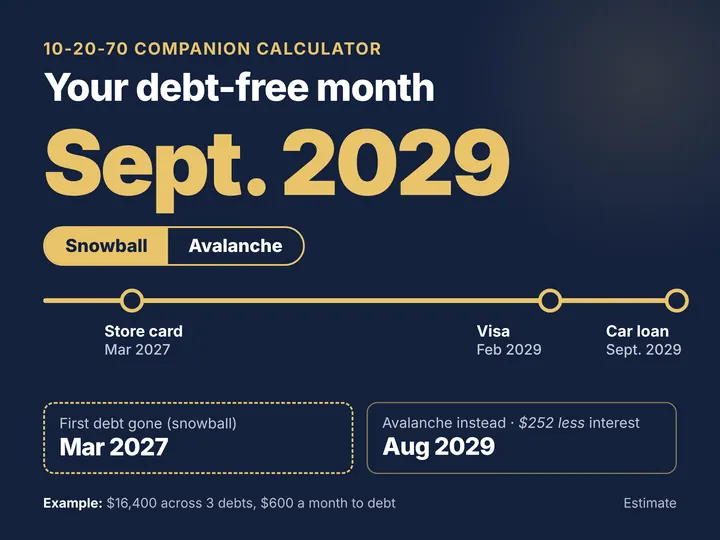
$16,400 across 3 debts: store card $900 · Visa $7,000 · car loan $8,500
Example: $600 to safety and $1,200 to debt every payday from December, smallest debt first. Your numbers will differ. Education only.
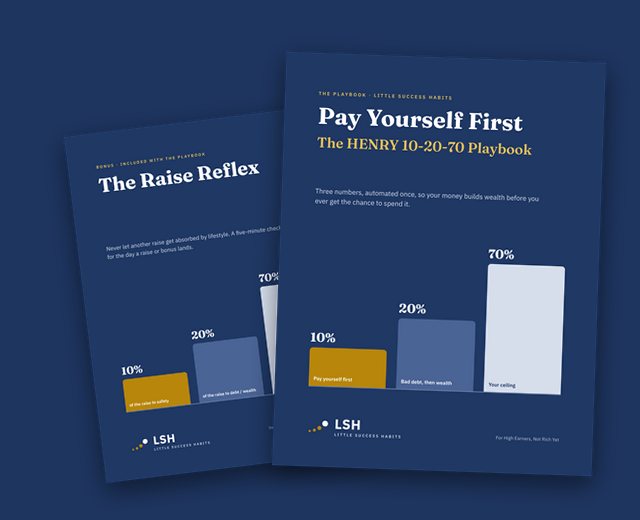
9-module PDF workbook with fill-in worksheets · Raise Reflex included

Parthiv, Founder, Little Success Habits
$19 until 30 Nov · less than one month's interest on that debt (about $220)
30-day guarantee · Setup in one evening · Raise Reflex included
No more saving whatever's left. There never is.
No more choosing between debt and savings.
No more raises that disappear in a month.
This isn't a budget. You decide once; it runs every payday.
Bills first. Fun second. You last.
Payday hits. Rent goes out. The car, the cards, the subscriptions. By month end you’re wondering where a good salary went.
You’re not bad with money. You pay every bill. Your money just pays everyone else first, and you get whatever’s left. There never is.
That’s why your raises disappear into a bigger rent or a newer car, budgets don’t stick (20 categories means 20 decisions a week), and paying debt first fails (one car repair puts it back on the card).
Nearly half of US consumers earning over $100K say they live paycheck to paycheck (PYMNTS, 2024). It’s common. It’s also fixable.
Flip the order. Set it once.
10% to safety. It moves on payday, every payday, building your cushion.
20% to debt, at the same time. Every debt payment lives here, minimums included. When the debt is gone, the same 20% goes to investing.
70% to live on. It’s a ceiling, not a target. Spend under it and the rest goes back to you.
Most plans make you do one thing, then the next. This runs safety and debt at the same time, so the cushion catches the hits while the debt keeps shrinking.
Example: on $6,000 a month take-home, $600 to safety, $1,200 to debt, $4,200 to live on.
Can’t do 10-20-70 yet? Most people can’t on day one.
The Playbook starts with your track:
Ready: you can run the full split this payday.
Building: you’re covering your bills but not the full split yet. This is where most people start, and you build up to it step by step.
Foundation: you lay the foundation first, by creating the margin.
We all start where we are.
What you get
Pay Yourself First: The HENRY 10-20-70 Playbook. A 9-module workbook with fill-in worksheets. Read it in order, fill in your numbers, and finish with your split automated.
Your track, and how to create the room if you need it
The 5 habits quietly keeping you broke, named
Your three numbers, worked out for your income
Your debt payoff order (snowball or avalanche), and how each payment rolls into the next
The automation setup: payroll split, payday transfer, or per-deposit for uneven income
The real leak: a fixed-cost audit, because it’s not the lattes
A 90-day tracker and a 20-minute quarterly reset
Included: The Raise Reflex. What to do the week a raise lands, so it turns into wealth instead of a bigger lifestyle.
Included: a step-by-step setup video. Watch me set up the automatic payday transfers, so yours run from your next payday. I never see your accounts or your numbers. Questions? Reply to your delivery email. I read every one.
Why this works
Automation does what willpower can’t. When savings increases were set up automatically around raises, savings rates went from 3.5% to 11.6% over 28 months (Thaler and Benartzi, 2004).
The idea is old: “a part of all you earn is yours to keep,” from The Richest Man in Babylon (1926). This Playbook rebuilds it for people who earn well and still feel behind.

Hi, I'm Parthiv.
I grew up around money stress, and in my twenties and thirties I lived it: into debt, out of debt, back in again.
About five years ago I finally crossed six figures. It didn't feel like it. I still couldn't answer one question: where is my money going?
What changed was one thought: next month's money hasn't been spent yet, so I don't have to spend it. I paid myself first, before anything else. I paid off my car, and that payment became margin.
A few months later I had my first $1,000 saved. For the first time, security was building instead of slipping away. The 20% to debt came next.
That was before I was married. We still do it today, in a different way: my paycheck splits itself on payday, before I see it. My family is in a stronger position because I am.
You can't dig yourself out of the hole if you're focusing on the debt. Pay yourself first.
Parthiv, Founder, Little Success Habits
$19 until 30 Nov
From 1 Dec it's $27.
30-day guarantee. If it’s not useful, email me and I’ll refund it.
Optional at checkout: the Companion Calculator, $17 until 30 Nov (then $27). Plug in your pay and your debts once and see your exact dollars.
Frequently Asked Questions
I already use a budgeting app. Do I need this?
Keep your app. It shows where your money went. This decides where it goes before you can spend it.
What if I can’t do 10-20-70 right now?
Most people can’t on day one. Module 0 gives you your track, and the Building track shows you how to grow into it.
Should I pay off debt or save first?
Both, from the same paycheck. That’s the point of the plan.
If you can’t fund both fully yet, keep your debt minimums paid and start saving first, even 1%. The 10% is the habit you build toward and never the number you cut. Every extra dollar after that goes to debt. Your cushion is what stops the next car repair landing back on the card.
I’m paid every two weeks. Does it work?
Yes, and it’s built for it. Split each paycheck the same way the day it lands: 10% to safety, 20% to debt, the rest to live on. Twice a year you’ll get a third paycheck in a month, and that one can go straight to your debt or your cushion.
My income is uneven (bonus, commission, freelance).
Move the split each time a deposit arrives. A strong month sends more to your 10% and 20% automatically.
I have a partner. Does it still work?
Yes. It runs on your own income, and your share of shared costs sits inside your 70%.
How do I get it?
Instantly by email, as a PDF. No login.
What if it isn’t for me?
Email me within 30 days and I’ll refund it. One refund per customer.
Education only, not financial advice. Results depend on your own numbers and actions. Questions: [email protected]